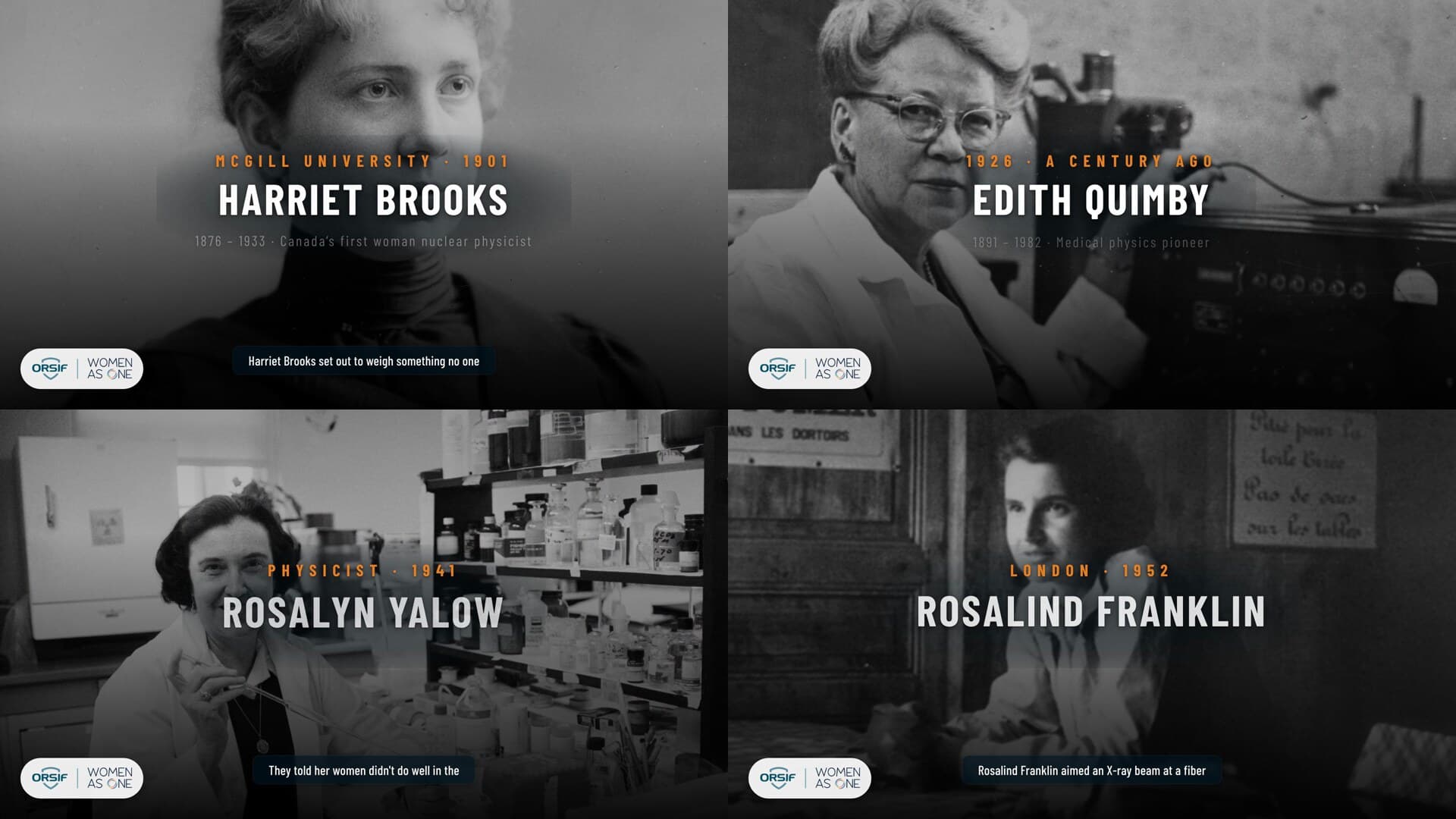
Radiation transformed modern medicine. It also asked a great deal of the people who first learned to work with it, often long before anyone understood the risks. This July, ORSIF partnered with Women As One on a series of four short films celebrating four women who shaped the science of radiation, and connecting their legacy to the interventional teams, so many of them women, who stand beside the beam today.
Since 2019, Women As One has opened doors for women in cardiology through funding, mentorship, and visibility on a global stage. We share their belief that women belong in this work. We would add one thing to it: they deserve to be protected while they do it. All four of these women were born in July, which is what inspired the timing: we released each film on or near her birthday, and each one closes on the safety science her era made necessary.
Harriet Brooks (1876–1933)
Born July 2, 1876. Canada's first woman nuclear physicist. Working alongside Ernest Rutherford, Brooks traced the invisible emanation rising off a radioactive source and showed it was a gas, far lighter than the element it came from. Her work was foundational to identifying radon, and she was among the first to observe an atom recoil as it transformed. She did this by hand, with thorium and radium, in an age before dosimeters, before shielding, before a single dose limit existed. The safety she never had is now the right of the teams who followed her.
Edith Quimby (1891–1982)
Born July 10, 1891. A pioneer of medical physics and radiation safety. Quimby spent her career measuring something most people never think about: where radiation goes during a procedure, scattering off the patient and filling the room. She became the first to measure what we now call radiation scatter, and her early film badge program helped build the safety practices that protect interventional teams to this day.
Rosalyn Yalow (1921–2011)
Born July 19, 1921. In 1941, Yalow was the only woman among hundreds of men in her graduate physics program. At the Bronx Veterans Affairs hospital, working with radioactive tracers, she and Solomon Berson developed radioimmunoassay, a way to measure substances in the body down to about a billionth of a gram. In 1977 it won the Nobel Prize, and Yalow became the first American-born woman to win the Nobel in medicine. Her career proved a simple truth: radiation is essential to modern medicine, which is exactly why the people who work with it deserve sound, evidence-based protection.
Rosalind Franklin (1920–1958)
Born July 25, 1920. In a London basement laboratory in 1952, Franklin aimed an X-ray beam at a fiber of DNA and let it expose her film for nearly a hundred hours. The image she made, Photograph 51, revealed DNA's helical structure and became evidence at the heart of one of science's greatest discoveries. Yet that photograph was shown to others without her knowledge, and for decades her name was left out of the story. She worked with ionizing radiation every day, in an era that too often left those who did unprotected. Today, women still work beside the beam, facing the same radiation she did.
Their legacy, our mission
Across a century, these four women helped build the science that makes today's interventional medicine possible. That science now protects the cardiologists, nurses, and technologists who spend their careers in the radiation field, and ORSIF exists to make sure that protection keeps pace with the risk.
Thank you, Women As One, for everything you do for this community. We are proud to have marked these four legacies with you.